
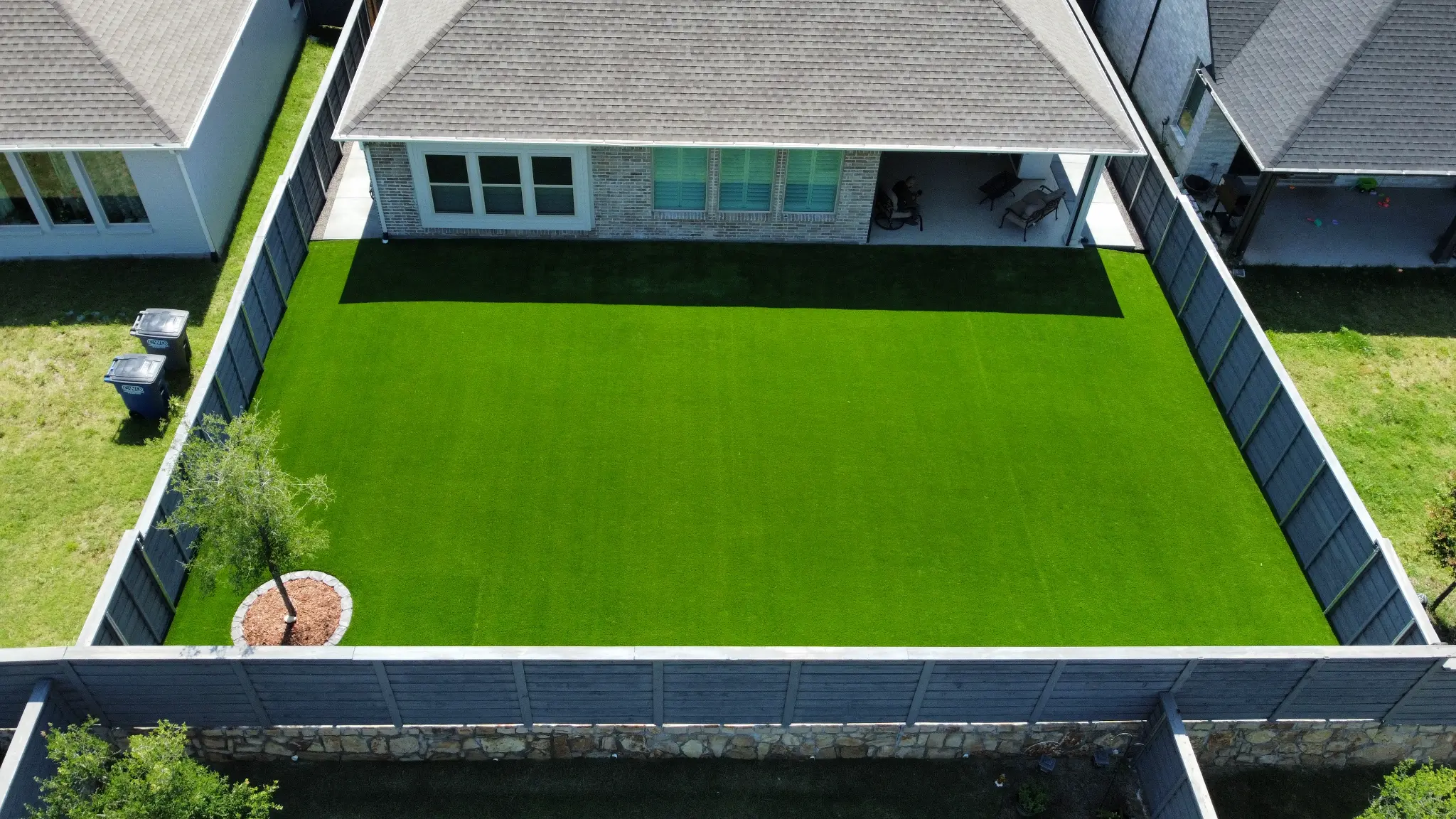
A turf base has to work with North Texas soil—not ignore it
At Emerald Green Turf, we build residential turf bases for the conditions we find on site across the Dallas-Fort Worth metroplex. Nick answers your questions and walks the project before we start. Quality. Premium. No shortcuts.
Some DFW properties sit in or near the Texas Blackland Prairie and other clay-heavy soils. The USDA Natural Resources Conservation Service (NRCS) says Blackland Prairie soils have high shrink-swell properties. Its Houston Black soil description says the soil is very slowly permeable when moist and can crack during dry periods. That does not mean every yard has the same soil profile, or that a soil-series description replaces an onsite assessment. It does explain why a thin, loose, or poorly graded base is a poor bet where clay and water management are part of the job.
For a typical residential turf area, our company operating specification is a prepared, compacted base with approximately 4 inches of decomposed granite (DG) and a planned 1–2% grade to move surface water. Final excavation, edge treatment, drainage details, and grade depend on access, hardscape, downspouts, and conditions in the yard.
If you are still choosing a surface, see artificial turf. If pets will use the area every day, begin with pet turf so rinse-down and cleanup needs are discussed before installation.
Start with the site: water, elevation, access, and clay
Before materials arrive, we look at the whole outdoor area—not just the square footage. We identify where water comes from, where it can go, and what it cannot cross: roof discharge, low spots, fence lines, patios, pool decking, planters, and doors. We also consider how new turf must meet pavers, concrete, or existing landscaping.
Clay makes this planning more important. The NRCS notes that Houston Black soil takes water in quickly when it is dry and cracked but very slowly when moist. In practical terms, a yard may behave differently after a dry spell than it does during heavy rain. We do not promise that turf or base rock will solve every drainage condition. We set base and finish elevations to avoid directing water toward the home or trapping it beneath the turf.
We also confirm intended use. A front lawn, dog run, side-yard walkway, and putting area have different demands. Putting greens are quoted separately after an onsite walk because contour, cups, fringe, speed, and transitions matter. If the project includes a durable access path or patio transition, pavers may be the right companion scope.
Excavation: make room for the complete system
Proper installation means removing enough existing material for the full system. We excavate the turf area, remove grass and organic material, and establish a rough subgrade before base material is placed. The target is a finished surface that meets surrounding elevations cleanly while allowing for the base, turf, and edge details.
Organic topsoil and loose roots are not a structural base. Left below new turf, they can decompose, shift, or hold inconsistent moisture. We remove unsuitable surface material as the site calls for it, then shape the exposed subgrade to support the planned drainage direction.
Careful excavation prevents problems that turf cannot hide: a base too high against a patio, too low at an edge, or flat where drainage is needed. Point out known irrigation, lighting, drains, and buried features during the walk. If a condition needs specialized repair or drainage work beyond the turf footprint, we will explain it rather than bury it.
Compaction: build in controlled layers
Compaction separates a long-term installation from a quick cover-up. After subgrade preparation, we install and compact base material in controlled lifts instead of dumping it all at once and hoping it settles evenly.
Loose aggregate can consolidate later under foot traffic, furniture, equipment, or seasonal moisture changes. The result can be soft areas, dips, edge movement, or seams that no longer sit correctly. Controlled compaction helps create a firm, consistent platform for the turf.
The base is shaped and checked through corners, narrow side yards, edges, and hardscape transitions. We cannot promise that variable clay will never move; we can prepare the subgrade, compact the base, and verify grade before turf is secured.
Why we use approximately 4 inches of DG
For a typical residential lawn, our operating specification calls for approximately 4 inches of decomposed granite after preparation and compaction. DG provides a compactable, workable layer beneath the turf. It gives us material to create a uniform plane and shape a deliberate grade.
“Approximately” matters. A yard is not level on paper. A low side may need a different amount of material than a high side, and hardscape elevations or excavation conditions can change the final makeup. We discuss significant site-specific changes before moving ahead.
A 4-inch DG base still needs a suitable subgrade, correct elevation, controlled placement, and compaction. It also does not eliminate the need to evaluate water entering from outside the turf area. Ask whether a proposal's stated base depth is compacted, whether excavation is included, and how it will tie into concrete, edging, drains, and grade.
Set a 1–2% grade and give water a destination
Our typical target is a 1–2% grade across the turf area: about 1 to 2 feet of fall for every 100 feet of run. That intentional slope gives surface water a direction to travel. The exact direction is determined by the property and existing drainage routes.
The grade must work with the house, patio, gates, drains, and surrounding yard. Where the site allows, we seek positive drainage away from structures and toward an appropriate existing collection or discharge path. We do not route water onto a neighboring property or assume where it is permitted to go.
Artificial turf is a permeable product system, but site drainage still matters. Water arriving faster than the ground and drainage path can handle may pond elsewhere. A good base supports the surface; it is not a magic fix for every low lot, blocked drain, or major runoff event. If dedicated drainage work or another trade is appropriate, we will flag that during the onsite conversation.
Why cheap bases fail on Blackland clay
Cheap turf bids often cut the work you cannot see: shallow excavation, too little base, no meaningful compaction, a flat grade, or unclear drainage planning. On clay-heavy sites, those shortcuts can be especially risky because soil moisture behavior changes over time.
The NRCS characterizes Houston Black as clay with high shrink-swell potential, very slow permeability when moist, and dry-period cracking. That is useful context for North Texas projects in applicable soil conditions—not a diagnosis for every DFW address. Fill, mixed soils, slopes, rock, drains, and hardscape can change the approach.
A low-cost shortcut may lead to:
- A thin base that telegraphs uneven subgrade conditions into the finished lawn.
- Loose material that settles at high-use areas, edges, or transitions.
- A flat finish that leaves water without an intentional path off the surface.
- Poor edge and elevation work that makes turf sit awkwardly against patios, pavers, gates, or planters.
- Ignored drainage sources that send more water into the turf area than it was designed to manage.
We do not sell a cheap base and call it premium. The visible turf is the finish; the prepared foundation is the work.
What the installation process looks like
Most residential artificial turf projects take 2–3 days, depending on scope, access, weather, drainage conditions, demolition, and hardscape integration. A straightforward workflow looks like this:
- Onsite walk and scope. We review use, edges, elevation, water flow, and turf selection.
- Excavation and cleanup. We remove the existing surface and make room for the system.
- Subgrade and base. We shape the area, install approximately 4 inches of DG for a typical residential lawn, and compact in controlled layers.
- Grade and drainage check. We verify the planned 1–2% fall and transitions before turf goes down.
- Turf installation and finish work. We fit, secure, seam, trim, and finish the turf to the layout.
- Final walkthrough. Nick reviews the completed area, care expectations, and project-specific notes.
Residential lawn turf is typically $8–$14 per square foot installed. Scope and conditions matter, so see our Fort Worth artificial turf cost guide for price drivers, then request a site-specific estimate. Putting greens are priced separately after an onsite walk.
Emerald Green Turf is insured. Eligible turf products include a 10–15 year manufacturer warranty, registered for the owner; product and warranty terms vary, and we review applicable coverage with your selection.
Plan the base before you choose the finish
A better artificial lawn begins with an honest site conversation. Tell us where water collects, where pets run, and how you use the space. We will explain the base plan plainly and build the scope around the yard.
Ready to talk through a Fort Worth or DFW project? Contact Emerald Green Turf or call (661) 733-7009. We are a family-run Fort Worth, Texas installer serving the Dallas-Fort Worth metroplex, available daily from 7 AM–5 PM.
Related internal links
- Artificial Turf — compare residential lawn turf options and plan a project.
- Pet Turf — discuss drainage, cleanup, and pet-use considerations before installation.
- Putting Greens — onsite-walk pricing and custom design for greens.
- Pavers — coordinate pathways, patios, and clean turf transitions.
- Fort Worth Artificial Turf Cost Guide — understand residential lawn turf pricing and scope drivers.
- Contact Emerald Green Turf — request an onsite discussion or call (661) 733-7009.
Frequently asked questions
Q: How deep is the base for a residential artificial turf lawn?
A: Our typical residential operating specification uses approximately 4 inches of decomposed granite after preparation and compaction. Final excavation and base requirements vary with elevations, site conditions, drainage, and nearby hardscape.
Q: Why does clay change how a turf base should be built?
A: Clay-heavy soils can respond differently as moisture changes. The NRCS describes Blackland Prairie soils as having high shrink-swell properties, and Houston Black as very slowly permeable when moist. That is why we focus on excavation, compacted DG, planned grade, and drainage. An onsite look determines what applies to your yard.
Q: Is 4 inches of DG enough for every project?
A: It is our typical specification for a residential lawn turf base, not a substitute for site evaluation. Depth can vary where grade correction, elevations, drainage, access, or adjacent features require a different approach.
Q: What does a 1–2% grade mean?
A: It means the finished turf is sloped about 1 to 2 feet over 100 feet so water has a planned direction of travel. The direction depends on existing drainage, patios, drains, and site conditions.
Q: Can artificial turf fix a yard with serious drainage problems?
A: Not automatically. A permeable turf system and well-built base can support normal surface drainage, but they do not solve every runoff, low-lot, downspout, or blocked-drain condition. We identify concerns during the onsite walk and explain if dedicated drainage work should be considered.
Q: How long does a typical residential turf project take?
A: Many residential lawn installations take 2–3 days. Access, weather, demolition, drainage work, pavers, and custom details can change the schedule.
Q: What does residential artificial turf cost in Fort Worth?
A: Residential lawn turf typically runs $8–$14 per square foot installed. Site conditions, excavation, base work, drainage, access, product choice, and edge details affect a proposal. See the Fort Worth cost guide and contact us for a site-specific estimate. Putting greens are quoted separately after an onsite walk.
Sources
- USDA Natural Resources Conservation Service, General Soil Map of Texas — identifies Texas Blackland Prairie clayey soils as having high shrink-swell properties.
- USDA National Cooperative Soil Survey, Houston Black Series — describes Houston Black as very slowly permeable when moist, with high shrink-swell potential and dry-period cracking.