A Fort Worth Turf Installer Who Starts With the Yard, Not a Sales Script
I’m Nick. Emerald Green Turf, LLC is a family-run turf installer headquartered in Fort Worth, serving the DFW metroplex. When you call (661) 733-7009, you speak with me—not a call center. I want to hear how you use the space, look at grade and access, and make a practical plan.
Fort Worth yards are not all the same. A Fairmount courtyard is different from a broad Tanglewood lawn. A Ridglea pet run has different priorities than a low-traffic Arlington Heights front lawn. And a putting surface should be designed for the strokes you want to practice—not priced as a generic lawn.
That is why I start with the site: where water moves, what stays shaded, access to the backyard, and how the finished edge meets a fence, bed, pool deck, driveway, or pavers. Then I recommend a turf system and scope that fit the job.
Quality. Premium. No shortcuts. That is the standard I bring to Fort Worth projects. For a residential artificial lawn, the installed range is generally $8–$14 per square foot, with the final figure depending on access, site preparation, drainage needs, edge details, and selected material. Putting greens are a separate build and are quoted after an onsite walk. If you are weighing options first, see our Fort Worth artificial turf cost guide and then contact me for a site-specific quote.
Fort Worth Properties We Serve
Fort Worth has established neighborhoods, infill lots, newer north-side development, wooded streets, hills, and tight side yards. The plan should fit the property rather than a neighborhood label.
We regularly welcome projects in Westover Hills, Rivercrest, Tanglewood, Ridglea, Arlington Heights, TCU/University Park, Fairmount, Monticello, Alliance/north Fort Worth, and the Benbrook edge. That can mean a refined front lawn that complements a historic-style home, a contained dog area behind a family home, a turf-and-paver entertaining zone, or a clean side-yard solution where natural grass has been hard to maintain.
A few local realities affect the conversation:
- Westover Hills, Rivercrest, Monticello, Arlington Heights, and Fairmount: mature trees, changing shade, masonry edges, irrigation, and limited access deserve close attention.
- Tanglewood, Ridglea, and TCU/University Park: play, pets, seating, and traffic can share one yard, so turf selection and edge restraint should match actual use.
- Alliance/north Fort Worth and the Benbrook edge: drainage, a defined turf area, and pavers may belong in the same plan. I separate included turf work from optional hardscape work.
No neighborhood is a promise about a specific yard’s soil, slope, or rules. An onsite look is how we avoid designing from an assumption.
Fort Worth Ground Conditions: Clay, Limestone, and Rock Change the Prep
The Fort Worth area crosses different prairie and geologic conditions. A dependable turf project begins below the surface, but regional descriptions are not a substitute for examining your property.
Blackland clay is the heavy, dark, calcareous and alkaline clay associated with the Blackland Prairie. Texas Parks and Wildlife notes that the region developed over Upper Cretaceous chalks, marls, limestones, and shales. These clay-heavy soils are a different condition from the limestone-ground Fort Worth Prairie. When a site has expansive or dense clay behavior, the practical question is not whether turf can go there; it is how grade, base preparation, and water movement should be handled at that location.
Grand Prairie limestone-derived clay is the more fitting regional frame for much of Fort Worth. Texas A&M Forest Service describes limestone layers interbedded with clays and shallow, well-drained dark clay soils. BRIT describes the Fort Worth Prairie as a Grand Prairie variant on mudstone and limestone bedrock, with clay and mud outcrops. It also notes alkaline clays that can hold water near the surface in rainy periods and dry and crack in dry periods. A level base and intentional water plan matter more than a quick cover-up.
Shallow rock toward Aledo becomes more relevant westward. BRIT says limestone bedrock is closer to the surface on the western Fort Worth Prairie, leaving thin, rocky soil. The USDA also describes limestone-derived soils that can be shallow to bedrock. A rocky or thin-soil site may need a different excavation, base, and edge scope than a deep-soil yard.
I do not diagnose or engineer soils from a photo. I assess the visible conditions, discuss any known drainage history, and set the installation scope around the site. If a project raises a question beyond ordinary landscape work, I will say so rather than oversell a simple answer.
What a Residential Turf Installation Looks Like
The details change by yard, but the work follows a disciplined sequence. This is Emerald Green Turf’s operating approach, not a city-mandated recipe.
First, we define the usable area and look at access, grade, sunlight, irrigation, trees, structures, and any area that should remain planting bed or natural ground. A lawn, pet area, and putting green are not interchangeable surfaces.
Next, we prepare for a stable, clean base and a finished plane that works with the surrounding space. Where needed, grade and drainage are part of the scope—not a low spot hidden under turf. We plan edge restraint so transitions to concrete, fence lines, beds, or pavers are clean.
Then we fit the turf, manage seams and grain direction, secure the perimeter, and complete the selected infill and finish details. I explain material choice before we start. The job ends when the surface, edge work, cleanup, and agreed scope are finished.
Most residential turf projects take two to three days. That is a typical timing window, not a guarantee. Weather, access, unexpected site conditions, curing or hardscape coordination, and project size can change the schedule. I would rather give you a clear update than make a deadline sound certain before I have seen the job.
Choose Turf by How You Live Outside
A good Fort Worth turf project is specific about the use case. A lawn product should not be forced into a specialty role.
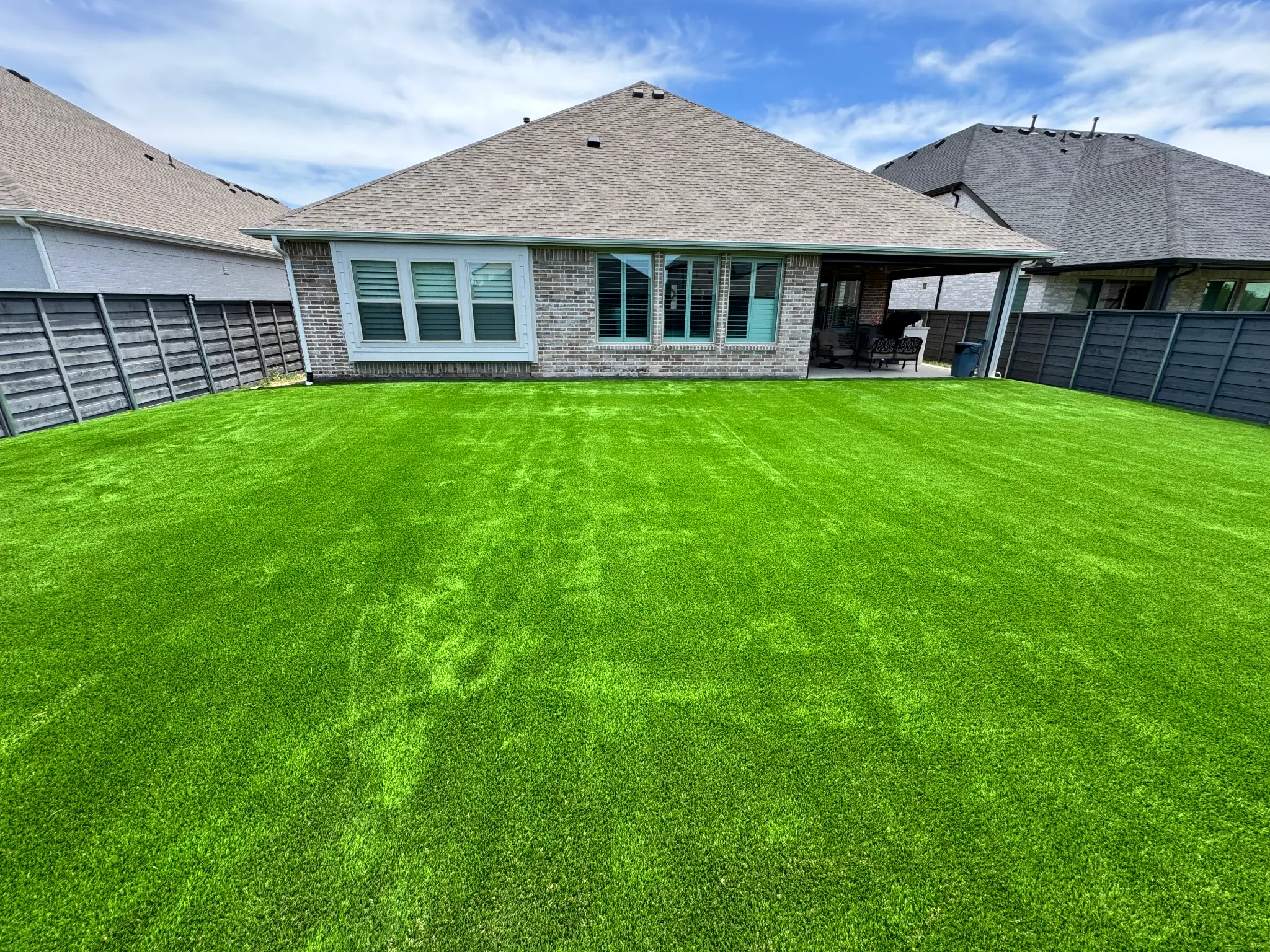
For a polished outdoor lawn, our artificial turf options are planned around use, shade, access, and the surrounding landscape.
For dogs, the design conversation changes. A pet turf area should consider pet traffic, cleanup, access, containment, and site conditions. Tell me how many pets use the space and whether it is a dedicated run or part of the main yard.
For golf, a putting green is quoted separately after an onsite walk. Size, shape, cup layout, fringe, slope, access, and practice goals all matter. We will discuss the strokes and look you want, then quote the scope.
For an outdoor room, turf and pavers can work together. Pavers may define seating, route foot traffic, create a border, or connect turf with an existing patio. The layout must respect drainage and elevations.
City Requirements and HOA/ARC Review: Check Before We Build
Property rules are a homeowner responsibility, but I will make the scope clear for your review. Do not confuse Fort Worth’s commercial landscaping standard with ordinary lawn replacement at a one- or two-family home.
Fort Worth Zoning Ordinance § 6.301 is the city landscaping section. It applies to specified commercial, institutional, industrial, manufactured-home park, RV-park, and certain private recreation construction—not to ordinary construction or expansion of one-family and two-family dwellings. Section 6.301(g)(2) expressly lists construction or expansion of one-family and two-family dwellings as exempt from that section’s landscape requirements. In plain English: the commercial-style landscape-area, plant-material, and irrigation provisions in § 6.301 are not the rule that sets a standard artificial-turf requirement for a typical single-family or duplex residential lawn.
That limited point does not mean every home project is rule-free. Fort Worth advises owners to identify the zoning district and overlay districts, then check the relevant regulations. Other rules, permits, easements, historic considerations, drainage concerns, or site-specific restrictions may apply. Use the City’s current code and project tools, or contact the appropriate department, for an official determination.
HOA and ARC constraints are separate from city code. In Texas, restrictive covenants can be contained in community governing or “dedicatory” documents. The Texas State Law Library notes that an architectural review committee may require approval before changes or additions; its authority is generally defined by the community declaration. Associations may regulate exterior material, color, visible edging, landscape changes, drainage, or submittals.
Before scheduling, obtain and read the current CC&Rs, architectural guidelines, and application requirements for your property. Submit the exact turf, border, paver, drainage, and landscape information your association requests; wait for written approval when it is required. I can provide a clear scope and material information for your package, but I cannot interpret your governing documents or approve the project on an HOA’s behalf.
Clear Pricing, Owner-Led Communication, and Coverage
For a residential lawn turf installation, our working range is $8–$14 per square foot installed. An onsite quote accounts for access, excavation, rock, drainage corrections, curved edges, removal, and transitions. When comparing proposals, make sure each identifies prep, base, turf, edges, drainage items, removal, and disposal.
Putting greens are quoted separately after an onsite walk. They are design-led projects, not lawn pricing with a different label. Pet spaces and turf-plus-paver layouts are also scoped around their particular conditions and materials.
Emerald Green Turf is insured. Turf material includes a 10–15 year manufacturer warranty, registered for the owner. I will explain the applicable product and registration information. Review the product documentation for covered conditions and exclusions.
Call (661) 733-7009 or email emgturf@gmail.com. We are available daily, 7 AM–5 PM. Bring me the real questions—the tight gate, the low corner, the dog run, the old irrigation line, the HOA packet, or the desire to combine turf with pavers. That is how we build the right Fort Worth project.
Start With a Fort Worth Site Walk
The best next step is simple: show me the yard. I will look at the area, listen to how you want to use it, and give you a scope that accounts for the property. Whether you are planning a Rivercrest lawn, Fairmount courtyard, north Fort Worth pet area, Benbrook-edge paver space, or TCU/University Park putting green, it starts with a useful conversation.
See our artificial turf, pet turf, putting greens, pavers, and Fort Worth cost guide pages, or go directly to contact Emerald Green Turf. I’ll give you the information I would want before making the same decision at my own home.
Internal Links
- Artificial Turf
- Pet Turf
- Putting Greens
- Pavers
- Fort Worth Artificial Turf Cost Guide
- Contact Emerald Green Turf
Fort Worth Artificial Turf FAQs
Q: How much does artificial turf installation cost in Fort Worth?
A: For residential lawn turf, Emerald Green Turf’s installed range is generally $8–$14 per square foot. The specific quote depends on the yard’s access, preparation, base, drainage needs, edges, removal, and selected material. We price the actual scope after seeing the site.
Q: Is a putting green priced at the same $8–$14 per square foot range?
A: No. That range is for residential lawn turf only. Putting greens are quoted separately after an onsite walk because shape, cups, fringe, contour, access, and practice goals affect the build.
Q: How long does a Fort Worth residential turf project take?
A: Typical residential turf installation takes two to three days. Project size, weather, access, material coordination, and site conditions can affect timing, so we confirm the schedule around the actual job.
Q: Does Fort Worth Zoning Ordinance § 6.301 require a single-family homeowner to install commercial landscape features with turf?
A: Section 6.301 expressly exempts construction or expansion of one-family and two-family dwellings from that section’s landscape requirements. It is not the commercial landscaping rule governing a typical residential lawn replacement. Other city, overlay, easement, drainage, permit, or site rules may still apply, so check current City guidance for your property.
Q: Do I need HOA or ARC approval before replacing a lawn with artificial turf?
A: Possibly. HOA and architectural-review requirements depend on your community’s current declaration, CC&Rs, guidelines, and application process. Review them and obtain written approval before work when your association requires it.
Q: Can you install turf on Fort Worth clay?
A: Yes, but the preparation should respond to the yard’s real conditions. Fort Worth-area clay can hold surface water in wet periods and dry or crack in dry periods. We evaluate grade, drainage history, and the desired finish during the site walk instead of applying a generic prep plan.
Q: What if we find shallow limestone or rock on the property?
A: Westward Fort Worth-area properties can encounter thin, rocky soils and shallow limestone. That may change excavation, base preparation, edge work, labor, and price. We identify visible conditions onsite and explain any added scope before moving forward.
Q: Can turf and pavers be installed in the same outdoor project?
A: Yes. Turf can be paired with pavers for patios, walkways, seating zones, or finished borders. We plan elevations and water movement together so the connection between materials is intentional.
Q: What warranty comes with Emerald Green Turf material?
A: Selected turf includes a 10–15 year manufacturer warranty, registered for the owner. We will provide the applicable manufacturer information for the turf chosen for your project. Review the warranty terms for covered conditions and exclusions.
Q: How do I reach Nick at Emerald Green Turf?
A: Call (661) 733-7009 or email emgturf@gmail.com. We are available daily from 7 AM–5 PM for Fort Worth and DFW turf projects.
Sources
The following public sources support the local, legal, and regulatory context above. Company pricing, process, timing, coverage, hours, warranty, and contact details are company-provided operating specifications.
- City of Fort Worth, Zoning Ordinance § 6.301, Landscaping — applicability and exemption for one- and two-family dwellings.
- City of Fort Worth, Zoning Ordinance — how property owners identify zoning and overlay rules.
- Texas Parks and Wildlife Department, Blackland Prairie Ecological Region — Blackland Prairie geology and heavy clay soils.
- Botanical Research Institute of Texas, Fort Worth Prairie — Fort Worth Prairie, limestone bedrock, clay, and thin rocky western soils.
- Texas A&M Forest Service, Grand Prairie and Plains — limestone-interbedded clays and shallow dark clay soils.
- Texas Legislature, Property Code Chapter 202 — restrictive-covenant definitions and enforcement framework.
- Texas State Law Library, Property Owners’ Associations: Restrictive Covenants — CC&Rs and architectural-review guidance.