The short answer for Fort Worth homeowners
For a typical one- or two-family home in Fort Worth, Section 6.301 of the Fort Worth Code does not apply its landscape requirements to construction or expansion of that dwelling. That is the practical starting point for a residential artificial turf conversation. But it is not the same thing as a blanket, citywide approval of every turf project in every location.
The city’s landscaping section is aimed at specific development activity, including new commercial, institutional, and industrial construction; qualifying commercial or industrial expansions; manufactured-home parks; recreational-vehicle parks; and certain private recreation facilities. Its exemption list includes construction or expansion of one-family and two-family dwellings. Section 6.301 also does not use the term “artificial turf.”
So, if you own a standard single-family or duplex home, Section 6.301 itself is not the rule that sets a residential artificial-turf requirement for your yard. Still, a good project begins with the full picture: your HOA or architectural review committee (ARC), the recorded restrictions for your lot, any permit-triggering work that is part of the project, drainage, utilities, easements, and the location of the proposed turf all deserve a look before installation.
I’m Nick. Emerald Green Turf is a family-run DFW installer headquartered in Fort Worth. I can walk the site, explain the installation scope, and build the turf portion correctly. Quality. Premium. No shortcuts. I do not provide legal advice or decide whether a rule applies to your property.
What Fort Worth Code Section 6.301 actually says
Read Section 6.301 for its scope rather than assume that “landscaping” means every residential yard project. Subsection (f) covers new commercial/institutional and industrial structures requiring a building permit; qualifying commercial/institutional and industrial expansions; manufactured-home and RV parks requiring a permit; and private recreation facilities in manufactured-home subdivisions.
Then subsection (g) lists exemptions. One of them is clear: “Construction or expansion of one-family and two-family dwellings” is not subject to those landscape requirements. The ordinance’s commercial landscape rules discuss required landscape area, plant material, irrigation, maintenance, and related plan review. It does not create a residential artificial-turf specification, nor does it say that artificial turf is categorically approved everywhere in Fort Worth.
Do not apply this residential reading to a retail site, office, multifamily project, or development with another use; those projects can fall within the section’s stated scope.
Why “not subject to Section 6.301” is not a universal green light
The responsible answer is more precise than a simple yes or no: Section 6.301’s landscape requirements exempt one- and two-family dwelling construction or expansion, but a yard project can involve matters outside that section. For example, a turf installation paired with a new hardscape layout, structural work, changes to grading, or activity in an easement may call for questions beyond the landscaping rule.
Start with a property-specific checklist:
- Confirm the property type and scope. Is this an existing one-family or two-family home, and is the work limited to a landscape surface replacement?
- Read your recorded restrictions and current community rules. The declaration, design guidelines, and any adopted ARC standards can be more specific than a city landscaping section.
- Ask whether approval is required before work begins. Get a written response from the HOA/ARC when possible, especially for a front yard or visible side yard.
- Identify utilities, drainage routes, access points, and easements. These are site-planning issues, not details to discover after excavation begins.
- Contact the appropriate City of Fort Worth department if your scope could involve a permit or another code question. Bring the site plan and describe the whole project, not only the turf surface.
This is a planning guide, not legal advice. City rules, plat notes, private restrictions, and project facts can change the answer. For an interpretation of a covenant, a dispute, or a permit requirement, consult the city, your association, or a qualified Texas attorney.
HOA and ARC approval can still control the project path
An HOA or ARC is a private layer of review, and it is often the first practical obstacle to clear. A community can require an application, sample, plan, color, pile height, drainage approach, edge treatment, or location review. Approval procedures may apply even when the city landscaping section does not.
Do not rely on a neighbor’s lawn, an old verbal answer, or a contractor’s guess. Request current design guidelines and submit what the committee asks for: a scaled plan, turf product information or sample, areas to be covered, hardscape, drainage direction, and photos if required. Keep the approval letter with your project records.
An approval request is also a good time to decide where the project stops. A clean turf field can be paired with a defined paver patio or walkway so the entrance, grill zone, or path has a deliberate hard surface rather than a patchwork of materials. If the property includes pets, identify the intended dog run or relief area in the plan and review a pet-turf drainage approach with the committee before work begins.
I can provide a straightforward project description for the scope I’m installing. I cannot guarantee an HOA or ARC decision, and I will not tell you to skip its approval process.
A fact check on Texas Property Code Section 202.026
You may see online posts saying Texas Property Code Section 202.026 gives a homeowner a specific right to install artificial turf or prevents an HOA from banning it. Treat that citation carefully. As checked against the official online text of Texas Property Code Chapter 202, Section 202.026 does not appear in the current chapter. It should not be used as the legal basis for an artificial-turf approval request.
The official chapter does include Section 202.007, which addresses certain restrictive covenants involving composting, rainwater harvesting, efficient irrigation, drought-resistant landscaping, and water-conserving natural turf. That wording is not the same as an express statewide artificial-turf authorization. Section 202.007 also says an association may restrict the type of turf used in new turf planting to encourage or require water-conserving turf, and it permits review of plans for drought-resistant landscaping or water-conserving natural turf in the circumstances stated there.
The practical takeaway is simple: do not assume a Texas statute overrides your HOA’s artificial-turf standards based on a Section 202.026 citation. Read the governing documents, follow the ARC process, and seek qualified legal guidance if the association’s position and the documents do not line up. This page intentionally does not offer a legal conclusion about any particular covenant or HOA decision.
Plan the installation around the yard, not only the rulebook
Once the city-and-HOA questions are answered, the work still has to fit the site. During an onsite walk, I look at usable area, grade, runoff paths, access, existing edges, and how the yard will be used.
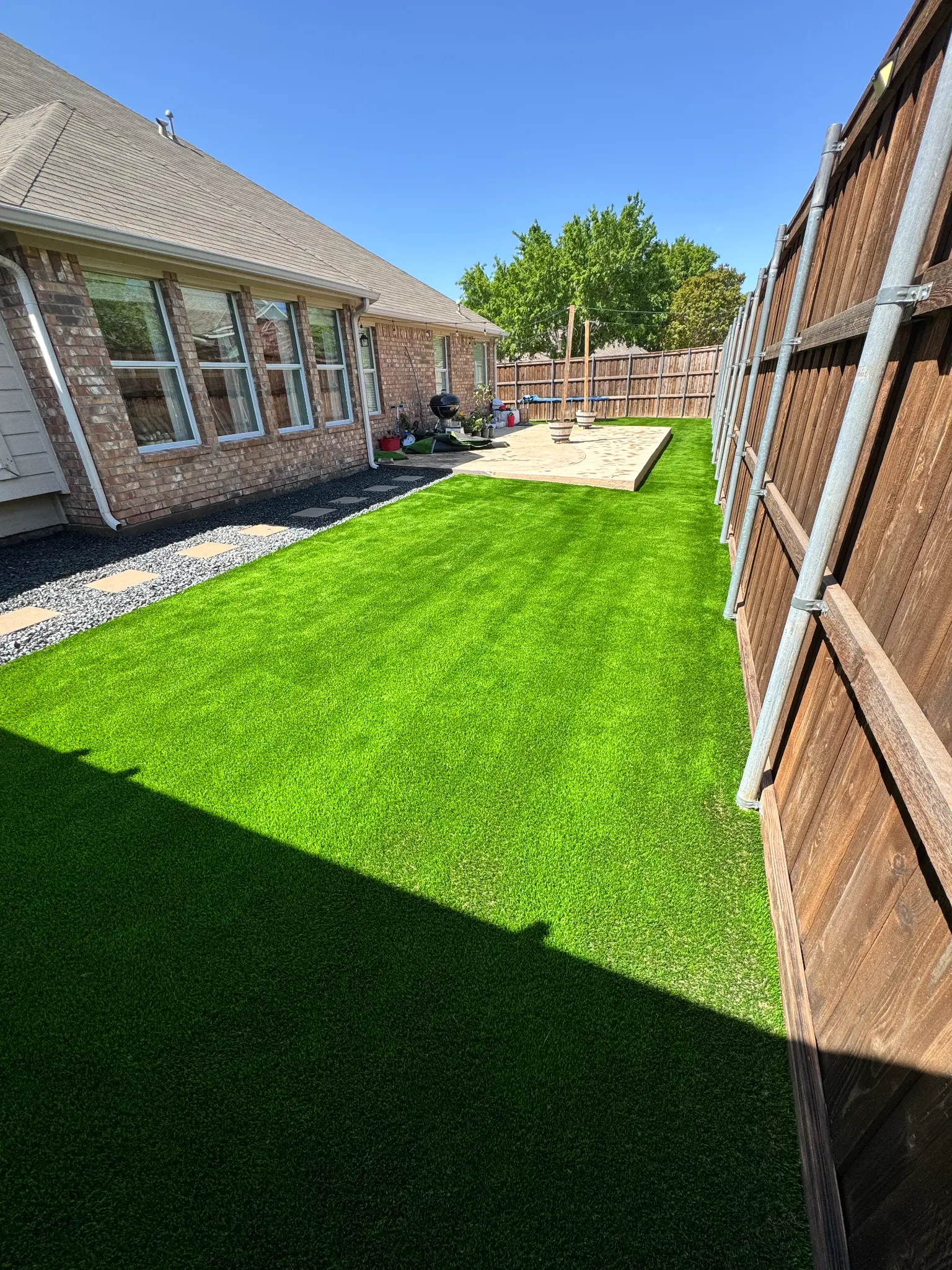
For a residential lawn, artificial turf installation can be the primary surface. For a dog household, the design should account for the relief area, cleanup access, and the drainage strategy—not just the color of the product. For golf practice, a custom putting green is a different design conversation: size, cups, contours, fringe, and access matter, so I quote putting greens separately after an onsite walk.
Turf plus pavers can create a defined circulation line, while turf and a putting green can create separate lawn and practice zones. The goal is a layout that respects the property and the approval you received.
Budget, schedule, and workmanship expectations
For residential lawn turf only, Emerald Green Turf’s working installed range is $8–$14 per square foot. The exact price depends on the site, access, preparation, turf selection, edges, drainage needs, and project scope. It is a planning range, not a quote. See the Fort Worth and DFW artificial-turf cost guide for the factors that move a project up or down.
Putting greens are not priced from that lawn-turf range. I quote them separately after an onsite walk because the design is driven by square footage, shape, cup count, contours, and surrounding work.
Most residential turf projects take two to three days once the scope is set and the site is ready. The product carries a 10–15 year manufacturer warranty, registered for the owner. Emerald Green Turf is insured. No one should promise a start date or an approval outcome before the project details are confirmed; field conditions and an HOA/ARC timeline can affect when work can begin.
A sensible next step and related links
Save the Fort Worth code link and your HOA/ARC requirements. Mark the proposed turf on a photo or rough sketch, including any visible side yard, common-area edge, drainage concern, or planned hardscape. That gives us a productive starting point onsite.
If you are ready to discuss a residential Fort Worth project, contact Emerald Green Turf, call (661) 733-7009, or email emgturf@gmail.com. Nick answers. We are available daily, 7 AM–5 PM. Bring the approval requirements if you have them.
- Artificial Turf Installation — residential lawn turf scope and project planning.
- Pet Turf Guide — planning a dog-friendly turf area and drainage discussion.
- Custom Putting Greens — a separately quoted design after an onsite walk.
- Pavers & Patios — hardscape options that can define a turf layout.
- Fort Worth & DFW Artificial Turf Cost Guide — the factors behind a residential lawn-turf quote.
- Contact Emerald Green Turf — request an onsite conversation with Nick.
Frequently asked questions
Q: Is artificial turf allowed at a Fort Worth single-family home?
A: Fort Worth Code Section 6.301 exempts construction or expansion of one-family and two-family dwellings from that section’s landscape requirements, and the section does not specifically mention artificial turf. That is not a property-specific legal clearance. Check HOA/ARC rules, recorded restrictions, project scope, and any city question that may apply to your lot.
Q: Does Fort Worth Code Section 6.301 approve artificial turf?
A: No. Section 6.301 is a landscaping section with a stated scope and exemptions; it does not expressly approve artificial turf. For a one- or two-family dwelling, its landscape requirements are exempted. For commercial, institutional, industrial, manufactured-home, RV, or other projects, do not apply the residential exemption without confirming the rules for the use and scope.
Q: Do I need HOA or ARC approval for artificial turf in Fort Worth?
A: Many communities require design review or prior written approval for visible landscaping changes. Your declaration and current ARC guidelines control the process for your community. Ask for the requirements and approval in writing before installation; the city exemption in Section 6.301 does not replace that private review.
Q: Does Texas Property Code Section 202.026 protect artificial turf?
A: Do not rely on that citation. Section 202.026 does not appear in the current official online text of Texas Property Code Chapter 202. Section 202.007 discusses water-conserving natural turf and certain related landscaping measures, not an express statewide approval of artificial turf. This is not legal advice; speak with a qualified Texas attorney about a specific HOA dispute or covenant.
Q: How much does residential artificial turf cost in Fort Worth?
A: Residential lawn turf from Emerald Green Turf generally falls in the $8–$14 per-square-foot installed planning range. Site preparation, access, turf selection, edges, drainage needs, and scope affect the final quote. Putting greens are quoted separately after an onsite walk.
Q: How long does a typical residential turf project take?
A: Typical residential turf work takes two to three days once the scope is set and the site is ready. HOA/ARC approval, weather, access, and other project conditions can affect the overall timeline.
Sources
- City of Fort Worth Code of Ordinances, Chapter 6, §6.301 “Landscaping” — scope of the landscape requirements and the exemption for construction or expansion of one-family and two-family dwellings.
- Texas Constitution and Statutes — Property Code, Chapter 202 — official chapter text consulted for the Section 202.026 citation and the text of Section 202.007.